Environmental Assessment and Feasibility Studies


What is a Municipal Class Environment Assessment?
A Municipal Class Environment Assessment (EA) is a process by which municipal infrastructure projects are planned, in accordance with the EA Act.
Purpose
The Class EA study is important to the decision making process for municipal infrastructure projects. The study evaluates the potential positive and negative environmental impacts of municipal infrastructure projects and includes road, water, and wastewater projects. It assists in the protection, conservation and wise management of Ontario’s environment.
Phase
The Class EA process consists of five phases, as follows:
- Phase 1 – Identify problems and opportunity
- Phase 2 – Identify alternative solutions and establish a preferred solution
- Phase 3 – Examine alternative design concepts and establish a preferred design concept
- Phase 4 – Prepare an Environmental Study Report
- Phase 5 – Implementation
Municipal infrastructure projects have varying levels of complexity and sensitivity to environmental impact, and as such, projects are classified in terms of schedule (i.e., Schedule A, A+, B and C). Depending on the Class EA Schedule, projects may not be required to complete all five phases of the Class EA process prior to implementation.
Current Projects
What is a Feasibility Study?
Feasibility studies are City projects which are not subject to the Municipal Class EA process in accordance with the Province's EA criteria.
Current Projects
| Crosby Avenue Extension Feasibility Study |
Virtual Stakeholder MeetingsVirtual Stakeholder Meeting #1 was held at 10 a.m. - 12 p.m. on September 13, 2024. Virtual Stakeholder Meeting #2 was held at 1 p.m. – 2:30 p.m. on November 21, 2024. Project BackgroundThe City of Richmond Hill will continue to experience population and employment growth through development and intensification. Yonge Street through the Village Local Centre Secondary Plan Area has been identified as a key growth and intensification corridor by the City of Richmond Hill Official Plan. Extending Crosby Avenue westwards to a new north-south local road, located immediately west and parallel to Yonge Street, is intended to increase local transportation capacity, provide access opportunities for new development, expand the finer grid network, develop new Active Transportation opportunities, and help establish the limits of the intensification boundary. The extension will consist of a fourth arm of the Yonge Street and Crosby Avenue intersection, on the west side of Yonge Street, which would then connect to a north-road road that will connect Benson Avenue to the north and Wright Street to the south. At the very least, this newly constructed road will be a public local road at the connections with Yonge Street and Wright Street. The general study area is bounded by Benson Avenue to the north, Yonge Street to the east, private land to the west and Wright Street to the south. The purpose of this feasibility study was to examine the potential alignment of this future road extension and the implications on various land parcels. A functional design of alternative alignment options was developed with a view to selecting a final preferred alignment option with a general consensus from impacted landowners. The preliminary design was then developed for the preferred alignment option. Study Area
DocumentationCrosby Avenue Extension Feasibility Study - Final Project Report (May 2025) Questions or CommentsPlease submit written questions or comments to the contact listed below. For more information regarding submissions and the collection of information, please contact the Project Manager at 437-451-4355 or by email at irfan.akram@richmondhill.ca. |

| Bantry Avenue and Briggs Avenue Active Transportation Improvements Feasibility Study |
Project BackgroundThe Bantry Avenue and Briggs Avenue Active Transportation Improvements Feasibility Study is set within the policy framework of Richmond Hill’s Transportation Master Plan (TMP), which envisions a paradigm shift in how people move around the City. The TMP proposes a mobility hierarchy, which prioritizes cycling and other modes of active transportation as preferred travel options. In the TMP. cycling facilities along Bantry and Briggs Avenues are identified as near-term priorities to enhance connectivity and accommodate cyclists of all ages and abilities. The corridors included in this study are critically located to enhance connections in Richmond Hill. Cycling facilities on Bantry and Briggs Avenues will connect existing neighbourhoods to Richmond Hill Centre, where the future Yonge North Subway Extension (YNSE) will support greater mobility choices. These facilities will also make it easier for residents and visitors to access key destinations, schools, community centres, parks and recreational facilities. The study involved developing design options for the corridors, assessing the feasibility of each, and creating a functional design for the preferred option. For each corridor, the report proposes both an interim and ultimate condition for cycling facilities, with the interim condition utilizing quick-build materials and the ultimate condition being contingent on future road reconstruction. Study Area
Public Information CentreA hybrid Public Information Centre was held on May 16, 2024, in-person at Langstaff Community Centre and online using Microsoft Teams. Questions or CommentsPlease submit written questions or comments to the contact listed below. For more information regarding submissions and the collection of information, please contact the Project Manager at 647-226-0215 or by email at jennie.geleff@richmondhill.ca. |

| Weldrick Road and Headford Avenue Active Transportation and Traffic Safety Improvement Feasibility Study |
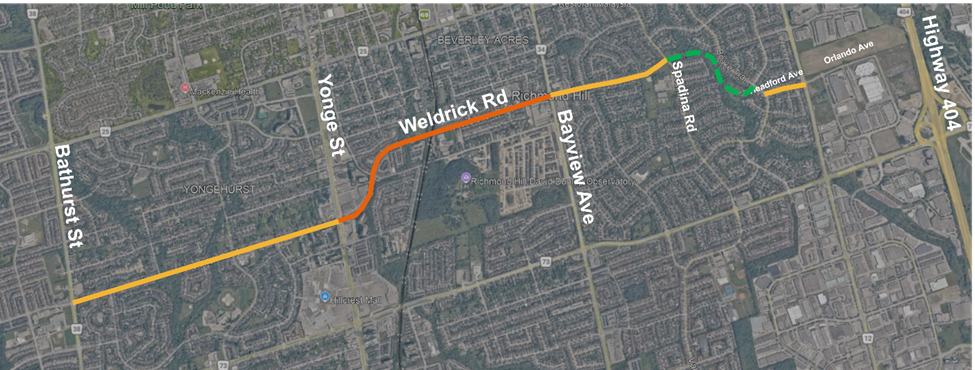
Project BackgroundThe City of Richmond Hill is undertaking a Feasibility Study to explore active transportation and traffic safety improvements along Weldrick Road (Bathurst Street to Spadina Road) and Headford Avenue, connecting to the active transportation facility on Orlando Avenue as part of the Highway 404 overpass project. The study commenced in spring 2026 and is currently underway. The primary objective is to identify active transportation and traffic calming solutions that improve safety, connectivity, and mobility for all users while supporting a broader range of travel options. This project is guided by Richmond Hill’s Transportation Master Plan (TMP), which promotes a shift toward walking, cycling, and other active transportation modes, and identifies Weldrick Road and Headford Avenue as priority cycling corridors to improve network connectivity and support users of all ages and abilities. The proposed improvements will enhance access to key destinations such as schools, parks, community and recreational facilities, transit, and surrounding neighbourhoods. Both interim (quick-build) and ultimate (future reconstruction) cycling facility options may be considered. Overall, the project will establish a key east–west cycling corridor, improving safety, connectivity, and sustainable transportation options across the city. Study Area
Public Information CentreA hybrid Public Information Centre was held on June 17, 2026, in-person at Bayview Hill Community Centre and online using Microsoft Teams. Questions or CommentsPlease submit written questions or comments to the contact listed below. For more information regarding submissions and the collection of information, please contact the Project Manager, Elnaz Abotalebi, by phone at 416-529-8104 or by email at elnaz.abotalebi@richmondhill.ca. |